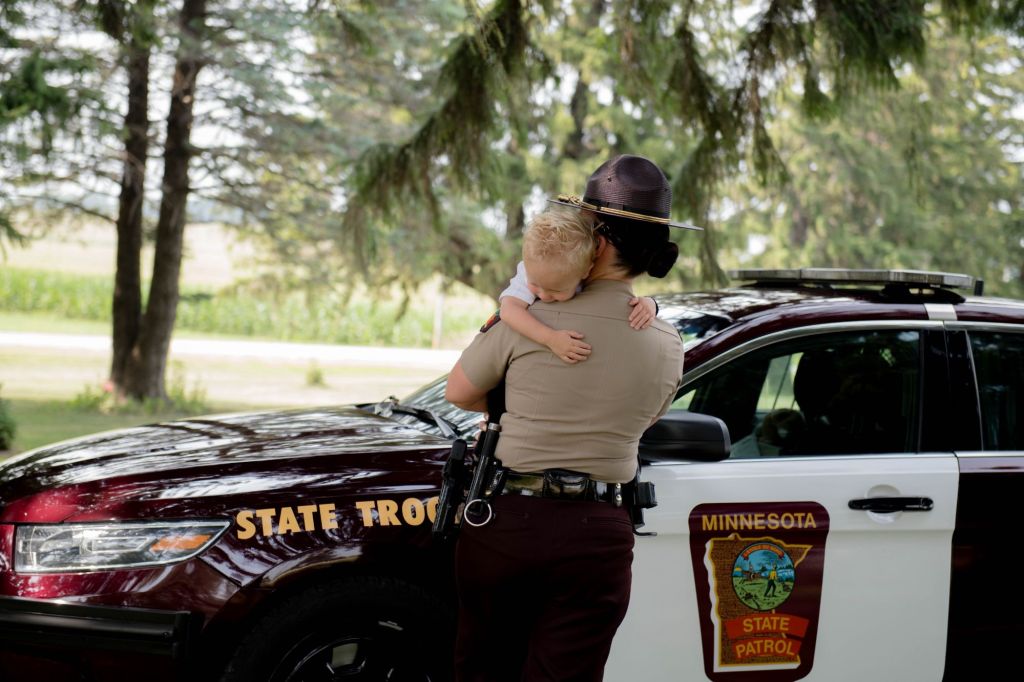
Behind the Badge

Who are you without the badge?

If I’m being honest, I am tougher with the badge then I am without it. I try not to rely on the system in order to survive and I rarely go along with mainstream narratives as I believe that thinking for yourself is important. I believe in making a contribution to the planet and taking care of it.

I am a crunchy mom who believes in living off the land. We raise animals, hunt and fish and even have honey! I’m trying to raise human beings that critically think. I hope my children do not become the criminals we deal with while on the job. In our home we have rules with an understanding that respect, support and love is to be equally given and received.

What lies beneath what people see on the surface?

What lies beneath the labels is deep seated grief, sadness and sometimes anger for the two miscarriages that I had. I lost two babies within two years. Western medicine makes miscarriages sound so common and normal, therefore I didn’t grieve over it. There was a feeling of “oh well, I need to move on.” 

I wish I would’ve dealt with it earlier because now I have no choice but to deal with it. It’s harder to work through it when you’re forced to. It’s been two years and I’m still working through it with a therapist because there’s an overwhelming amount of grief. The grief arises out of nowhere and shows up in all forms. It’s easier to ignore and try to push past it but it isn’t that easy when something triggers it. The layers feel never ending and the emotions are so intense. These have been struggles that I didn’t know were going to be struggles and now they are mine to deal with it. 

Do you think there were defining factors that contributed to the miscarriages? 

The role stress plays in our health is vastly underestimated. It has societally become a badge of honor to fit more in and constantly be working, running or doing. For two years I was a crash reconstructionist. It was eye opening to realize the amount of stress this job carried, which I couldn’t see until I was no longer in that environment. 

After my first miscarriage I was asked how much stress I was under, I said none. After my 2nd one I quit that position and realized how much lighter I felt. I had learned how to adapt in that environment and didn’t have a clue as to the toll it was taking on my body. 

After the second miscarriage I realized something was wrong. All the tests showed normal and yet, intuitively I knew something wasn’t. I started working with an acupuncturist who confirmed I had more going on, which was later verified through a scan. Alternative practices started making the most sense in terms of how our bodies operate and finding the root cause. I learned that we are unknowingly consuming so much poison. This excessive intake is contributing to so many health ailments and people don’t realize that many of these issues stem from how we treat our body and what we put in it. However, insurance doesn’t cover a lot of alternative modalities so I stopped seeing some of these practitioners due to cost. Invitro was an option but it was a lot of money for no guarantee. I felt as though I’d done everything and yet it felt like dead end after dead end.

What is grief to you and what stages have you gone through? 

It’s not a learned process that is talked about or deemed as “normal.” Many just expect a person to move on after a miscarriage or loss. I just want to be able to talk about it without crying. It’s so hard. It feels as though I will never get to that point. There’s still people consuming drugs that are getting pregnant. It’s hard not to question why things are the way they are or why we get dealt the hands we do. 

Do you and your husband grieve differently? 

Completely. I watch him and wonder what I’m doing wrong. I feel as though I’m constantly comparing myself to him and everyone else. I don’t know if it’s the way society has trained men to cope with emotions or if it isn’t innately a part of them to express but it can feel as though we’re in two different universes when it comes to grief. It makes me feel like I should be further along in the journey then I am. 

How has your faith played a role in coping?

I have always relied on the church and spiritual practice to get me through tough times. I made a bargain with God after my last miscarriage that “If I can’t carry a baby full term then I don’t want to get pregnant” and I haven’t been pregnant since I said that. Be careful what you wish for because sometimes it can come true in a way you didn’t intend.

It feels impossible not to ask questions like WHY or HOW?! Miscarriages happen to people everyday. How can I get pregnant and deliver one child and then not be able to carry full term after that? I don’t understand it. God made our bodies to have babies and yet mine feels defective. What am I doing wrong? What have I done to deserve this? Why is this happening to me? Why our babies? Why are people who don’t want children able to conceive when they won’t care for them? Then, I’ll read a bible verse that often provides a sense of peace. It’s a tug of war with my faith. I think many that have faced adversity can relate. It doesn’t fix the situation that’s happening, but it can provide some insight and internal peace knowing that this is all for a larger cause, whether I can see it or not.   

What is something you want others to know about miscarriages? 

Grieving is hard but it’s important. Get whatever help you need, whether that’s therapy, a support group or seeking out alternative practices. I have sought out different modalities on my journey and learned something from each of them. Recently, I wrote letters to the babies and got a tattoo in their memory. I was surprised at the weight that was lifted after getting the tattoo, it was the relief I very much needed. 

Despite what societal norms say, it is a loss and it’s taxing on your body. Allow yourself time to recover physically, mentally and emotionally and know that each person’s journey is specific to them. Most importantly, remember that you are not alone and you deserve the support! 

** Don’t forget to read “Part 1” of Kara’s story, “Chasing Tailights.“**

Chasing Taillights

Life is a tapestry of events. One event leads to another as it weaves a web that often makes sense in reverse. Kara’s story focuses on two pivotal incidents that left defining “before and after” moments. One that led her to being a state trooper, the other led her to this entry. Welcome to Kara’s story.

Was there a defining moment that put your dreams into action? 

Yes, it was January, 2012. I was standing on the side of the road taking pictures as hundreds of squad cars from far and wide escorted my friend, Shawn Schneider’s, body to his final resting place. Something deep within me stirred as I watched officers from all agencies across the country gather to pay tribute to a man who willingly lost his life for a stranger. After the service, a Chicago police officer gave me a patch and I realized that I wanted to be a part of this family, a brotherhood. 

Prior to this, I had a 10 year career as gas station cashier while doing photography on the side. I was married and often thought about becoming a volunteer firefighter. My own self doubt mixed with others’ opinions detoured me from pursuing this path. Instead, dreams remained just that… dreams.

That moment was the moment that altered my trajectory in more ways than I imagined. Over the course of the next year I became a volunteer firefighter and began taking classes to pursue my two year degree in law enforcement. My personal life also shifted, as my husband and I divorced. While I originally envisioned myself being a county deputy, I realized that chasing tail lights as a State Trooper was a better fit for me. A State Trooper handles anything that happens on a state highway, this includes but is not limited to, enforcing traffic laws, clearing blocked roadways or offering roadside assistance during emergencies. Being a trooper also allows me to assist other agencies in need. In December of 2016 I was accepted into the academy where I would complete the State Patrol training. 

The quote “sometimes bad things fall apart so better things fall together” seemed to be accurate. This trajectory is everything I imagined it to be. Doing this work filled me with a sense of duty and commitment to the public. I felt a sense of belonging, camaraderie and brotherhood. I truly feel as though I’m being of service to a greater good. Although there is a chain of command, I respect and understand why we do what we do and the reasons behind it. 

Can you identify a pivotal moment in your career that altered how you do your job?

Yes. It was the moment I stepped off the bus into the Minneapolis riots in May of 2020. I left my 7 month old son and husband at home for what some would consider a war zone. Every ounce of assurance, confidence and training as a trooper felt as though it meant nothing as I entered the streets of a burning city. I was terrified and overwhelmed by what I witnessed. What is even more terrifying were our orders to stand down and hold the line. We were instructed as to what we could do as we watched the horror of looting, defamation, and assault unfold. We were screamed at, spit on and assaulted. The only time we were permitted to intervene was if someone was in life threatening danger. How is it that we can watch crimes be committed right in front of us and not take action when our very job is to stop criminal activity? Buildings were on fire, people were rioting, humans treated other humans with utter disdain and disrespect. I have never witnessed anything like this and I hope I never will again. 

As troopers, our job requires us to respond to situations that have little to no control. We are there to coordinate order, it is a large part of what we do. We add calm to the chaos and restore a sense of safety and security in less than ideal situations, but this was… different. We didn’t have the backing from our superiors to create order, justice or peace, it was anarchy. 

This incident sets the precedent for what is to come, which is not only a huge societal shift, but it alters the way we perform our jobs. From this moment forward we are told to decrease petty offenses such as expired registration as it is better to focus on speed as we can’t be blamed for racial profiling. 

What is fact versus fiction, myth versus truth, that people tend to believe around this profession?

I would be willing to argue that 90% of what is fed through the media is fiction. The public is getting very, very limited pieces of the story and that’s assuming the media cares to capture any of the truth. A good example is a bodycam. A video is not as accurate as it appears. There is a lot happening when we respond to a call and the cameras do not pick up on everything. You may think that because you saw it on a body cam, it feels as if you were there but it’s tunnel vision compared to the peripheral vision of an officer/human. It’s a limited point of view in comparison to the reality of the situation. 

Another example is the riots that began on May 26th, 2020, even though the state was in lock down. Minnesota reopened on May 31st, 2020 with heavy instruction to limit exposure. However, hundreds, if not thousands, were allowed to for Floyd’s memorial and protest. The message was very contradictory as to what was allowed and what wasn’t. We were being told that lock down was for the safety of the greater good but not during certain circumstances.

Many act as though there’s a simple fix to complicated situations we come across. My question is, if things were as easy as people assume they are, why isn’t everyone signing up to do this job? People are quick to tell us what we did wrong when they see it on social media. It is easy to judge a situation when you’re looking at it through a screen. To put it into context, picture yourself playing a sport on a field or court versus being a spectator sitting on the sidelines. There is a big difference in what you see from the stands versus what you see while you’re in the game. Can you imagine someone coming to your place of employment and critiquing the partial view of what was caught on camera? How would you respond to someone telling you what you did wrong or how you should have done it differently? That is the reality when the media provides half (at best) truths to the public. 

What is one of the greatest threats facing law enforcement today?

The lack of support from the government. Everyone is pitted against each other and people don’t realize the ways in which it’s done. For example, during COVID we were told to limit our contacts with the public, even if people were committing violations. The divide is created by the media and the government does little to nothing to create a bridge to better our societies. This has become increasingly obvious since 2020. People want safety but noone wants to be held responsible if they’re in the wrong.

What are the most courageous things you’ve witnessed in the field?

Courageousness is in the eye of the beholder. People do alot of courageous things daily. When it comes to this profession, putting the vest on everyday and entering on what some days can feel like an ungrateful society, is courageous. It is the ultimate sacrifice to lay down your life for a complete stranger. Shawn’s sacrifice still reminds me of that. 

If you could change one part of society’s perception about this profession, what would it be?

My first question is, why are we the bad guys? Just because we deal with bad guys doesn’t mean we’re bad. People threaten their kids with us, that we’ll come and take them if they’re naughty. I know it’s not meant maliciously, but we’re painted by society as someone to be feared. We do good things outside of arresting people. We attempt to be seen in the communities and curate relationships with citizens to the best of our ability.  

Not everyone in this field is abusing power or is ego driven. Projecting this negative persona of the profession onto the rest of us, isn’t fair. A majority of us are trying to uphold our duty to serve and protect the masses without harming or traumatizing others. We have families and people we love, too. We want to keep citizens, as well as our families and children safe. At the end of the day, the goal for everyone is to go home safely. 

What changed about the way you perform your job that the 2020 riots brought about?

 I am more mindful about who I pull over and where I pull people over. If I run a license plate and it’s stolen, there is a lot more thought that goes into how I navigate the stop. I am more aware of where my backup is located in accordance to me. After the riots I was less likely to pull over or ticket people of color because I didn’t want to add to the racial divide. But after awhile you realize that people will blame you for race no matter what. We can profile cars, not people. I ticket almost everyone for 20 mph over the speed limit, that has nothing to do with race. Fewer people are accepting personal responsibility for their actions. 

How has your perspective on life changed since joining the force? 

Since I’ve joined the law enforcement brotherhood, I have realized how fragile life truly is. Prior to doing this work, I lived in my own little world, thinking nothing bad happens. It made me realize that this is not the reality of the world. I don’t believe people are evil at their core, but people do evil things. People can be unkind when they are trying to survive. As is the case in any profession, nationality, race, etc. there are a few bad apples that can give others a bad name.

The reality is, we have to be thick skinned in this profession. We wouldn’t make it home if we weren’t. I remember being told by a college instructor that the goal of every officer during their shift is to go home. It is better to be tried by 12 than carried by 6. There were many moments in those first 24 hours while I was in Minneapolis that I questioned if I would be tried by 12 or carried by 6. We all have our own personal struggles, hardships and triumphs. We are trying to figure out this thing called life as well.  I’m a mother, a wife, a daughter, a sister and a friend. I am many things beyond this badge. All of which I hope to return to. 

Stay tuned for Part 2 of Kara’s story “Behind the Badge”